

Board Proclaims January 2026 as Radon Action Month in Pottawattamie County
Posted January 15, 2026
Posted by Board of Supervisors and Public Relations
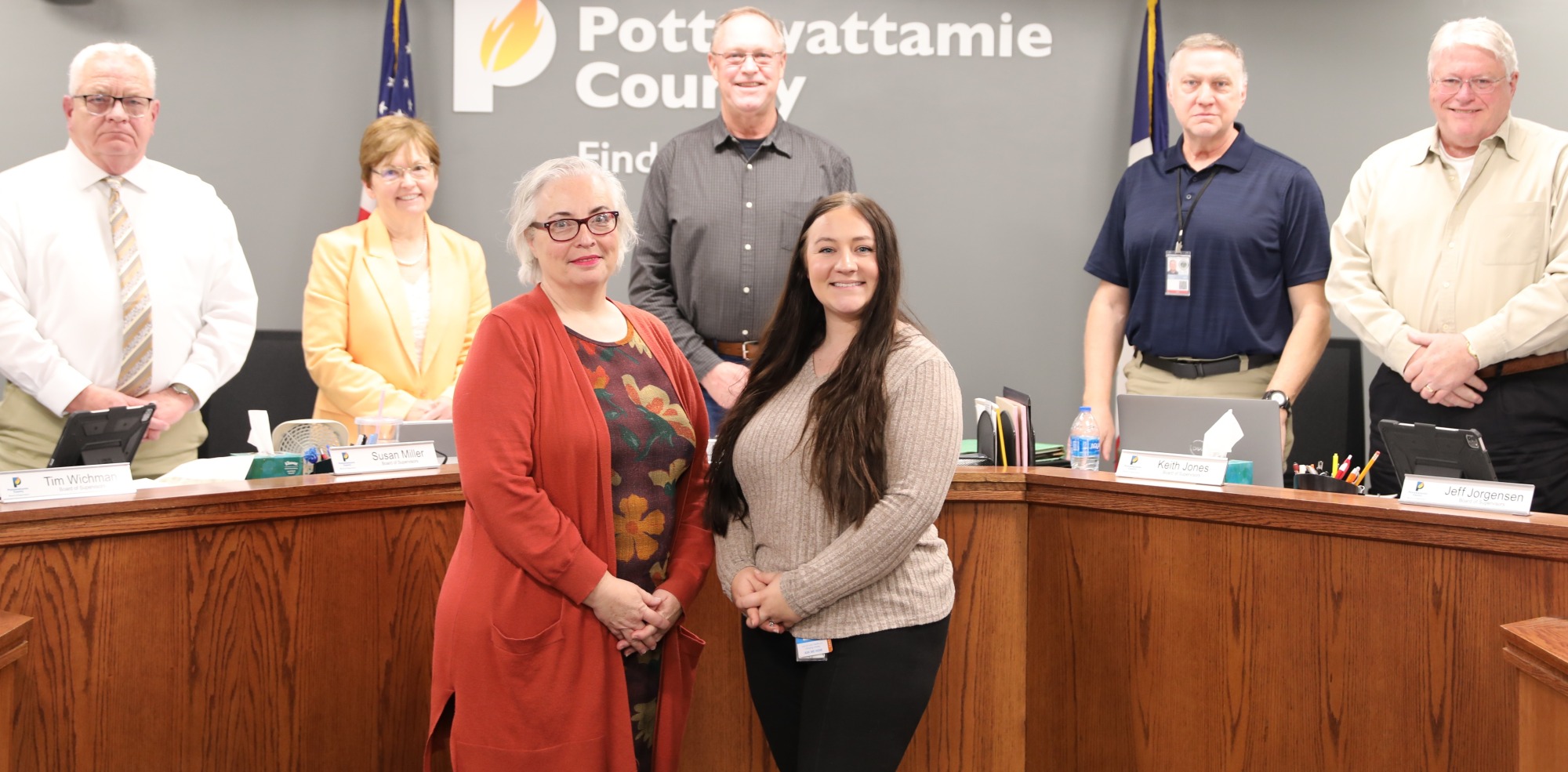
The Pottawattamie County Board of Supervisors has proclaimed January 2026 as Radon Action Month, encouraging residents to take simple steps that can help reduce lung cancer risk and protect indoor air quality.
Radon is a naturally occurring, colorless, odorless radioactive gas that can build up in homes and other buildings. Long-term exposure can cause cellular damage in the lungs and may lead to lung cancer. Radon exposure is the leading cause of lung cancer among non-smokers and the second leading cause overall in the United States.
Iowa is known to have higher-than-average radon levels, and any home in Pottawattamie County may have elevated radon levels, even if neighboring homes do not. Testing is the only way to know your home’s radon level.
“Radon is a serious health risk, but it’s also something we can take action on,” said Candy Steenbock, Pottawattamie County Public Health Epidemiologist. “Testing is simple and affordable, and if radon levels are high, mitigation systems can reduce exposure and help keep families safe.”
Pottawattamie County Public Health plays an important role in reducing lung cancer risk by promoting radon awareness and encouraging residents to take action. The county also partners with statewide prevention efforts supported by the Iowa Cancer Consortium, which works with local public health agencies to help reduce the burden of cancer across Iowa.
What residents can do
-
Test your home for radon. Short-term and long-term tests are widely available and easy to use. The American Lung Association has a free radon test kit program for Iowa. You can learn more about the program and eligibility for a free test here: https://www.lung.org/ia/radon-in-iowa Pottawattamie County Public Health also has radon test kits available for $11: https://www.pottcounty-ia.gov/public_health/radon_test_kits/
-
Take action if levels are elevated. Mitigation systems can reduce radon levels and improve indoor air quality.
-
Consider radon-resistant construction. If building a new home, ask your contractor about radon-resistant features.
For more information on radon testing, mitigation, and prevention resources, visit:
-
Iowa Cancer Consortium – Radon Information: https://canceriowa.org/radon/
-
Clearing the Air: Radon Myths and Facts: https://canceriowa.org/clearing-the-air-radon-myths-and-facts/